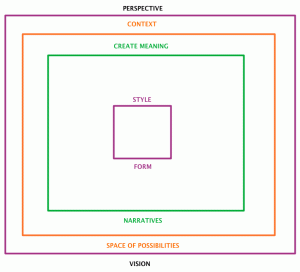

In response to the comments I received on the series Putting into play, I have produced a set of patterns showing the hands-on structuring of narrative and cognitive elements. Additionally, it keeps my time restraints from holding back curiosity.
In response to the comments I received on the series Putting into play, I have produced a set of patterns showing the hands-on structuring of narrative and cognitive elements. Additionally, it keeps my time restraints from holding back curiosity.


“Putting into play” is about how our thinking and understanding work when putting the thoughts into play towards the desired goal in the making of an engaging and dynamic game system. The series is a part of a project whose goal is to offer a hands-on approach to the design of a motivating and meaningful experience from a narrative and cognitive perspective which illuminates how our thinking, learning, and emotions interplay.




“Putting into play” is part of more than a one-year-long project which goal is to explain from a cognitive and narrative perspective the mind and hands-on approach to the design of an engaging and dynamic game system. With help from cognition-based models, the focus is on the opportunity to explore how our thinking, learning, emotions work when setting out from scratch towards the desired goal.
To make the most of the post, I recommend reading Part 2 and 3 of the series Putting into play, which provides an orientation.
The series Putting into play is part of a more than a one-year-long project which began when I received a request from readers. They had noticed how the cognition-based method Narrative bridging (Boman, Gyllenbäck, 2010) provided an overlook and control of the organization and arrangement of the information (also known as plotting) in the design of an engaging and dynamic game system. Since it is one thing to show how narration and cognition interplay as systems in a game that already exists of which the outcome can be evaluated, but quite another to start from nothing when putting thoughts and feelings into play. When readers expressed curiosity in learning how to use the method from absolute scratch in a hands-on tutorial, a ten-year-old conundrum reemerged concerning the minds-on part of the process.

I wonder if you remember the feeling that slowly came over you when you wrote what would become your last letter to Santa? If you have never written to Santa or, you are still writing, maybe you have the experience of buying a lottery ticket and is thus able to recognise the feeling of doubt when questioning your beliefs, intentions, and desires, as to why you are putting hopes into something you know won’t correspond to your desires? The feeling I´m trying to describe is the same I have every time I return to science in matters that concern the narrative, which is complicated, to say the least. So in January, I decided to settle the relationship, with the same confidence I had when writing my last letter to Santa I wrote my last words to science in my text “Are you a man or a mouse.”


Based on a question on how to use the narrative in the testing of an experience I will explain what it means to have a cognitive approach to the narrative and how to approach a quality assurance from a narrative perspective beyond templates and strong structures.

A schemata is a pattern of thinking that describes our seeking for meaning and how we categorize information and store it in small boxes that we call our memory, which forms our experiences and knowledge. What meanings we are creating from a narrative perspective is not easy to tell. However, what isn´t that unpredictable and arbitrary as we might think are the schemata that are running like a goal-oriented vehicle that makes us look for causes and consequences in familiar patterns.


Have you ever wondered how surprises relate to our emotions beyond physical reactions and the horror genre? Would you like to know how a narrative constructor thinks in the creation of curiosity, surprises and suspense and how the cognitive vehicle of narrative works?


For a number of years ago, I lived in a rainforest until one day I couldn’t stand not being able to see the horizon and the only thing I was staring at was my skin looking for leeches that appeared from nowhere looking like a stroke of a pen on the skin. If not being attentive to the thin black line and remove it quickly, it wouldn’t take long before you found a lump, big as a plum, attached to the skin that had to be unscrewed. The only thing I felt sorry about by leaving was to miss the yearly event when people from the distant and widely spread cattle stations gathered in the village to find a life companion. It was the biggest event of expectations I had ever experienced until E3 turned up.
 KATARINAGYLLENBÄCK
You must be logged in to post a comment.